
A foremost institute for health and safety is not defined by the number of students it enrolls, but by the weight its certification carries in a courtroom or a catastrophic site investigation. It is an entity that sets the benchmark for pedagogical excellence, regulatory foresight, and practical application. In an era where “safety” is often reduced to a bureaucratic hurdle, a premier institute reclaims the term as a fundamental pillar of operational efficiency.
The importance of trusted institutions cannot be overstated. When a bridge is built, a chemical plant is commissioned, or a hospital is managed, the “invisible hand” of safety protocols prevents disaster. These protocols are born in specialized institutes. Without a centralized, rigorous authority on safety education, workplace standards would crumble into a chaotic mix of guesswork and negligence.
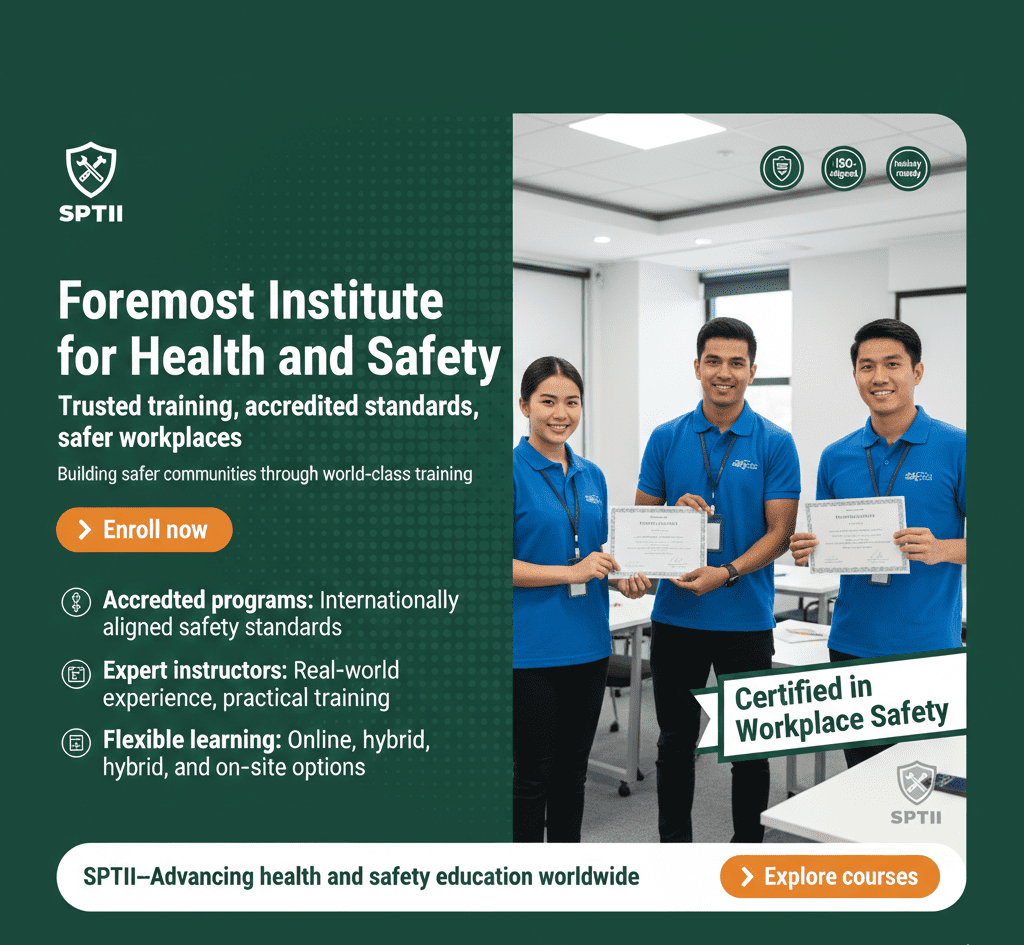
SPTII (Safety plus training international) occupies this critical space. As a platform dedicated to advancing safety education, SPTII does not merely distribute information; it transforms raw data into actionable intelligence. It serves as a bridge between high-level international regulations and the boots-on-the-ground reality of modern industry.
2. The Role of Institute for Health and Safety
To understand the value of a foremost institute for health and safety, one must analyze the three pillars of their functional utility.
Training and Certification
The primary objective is the validation of competence. Professionalism in safety requires more than “common sense.” It requires a deep understanding of physics, psychology, law, and engineering. A leading institute provides accredited courses that serve as a standardized currency in the global job market. When a professional holds a credential from a top-tier institute, the employer gains a guarantee that the individual can identify a hazard before it manifests as an injury.
Compliance and Standards
Global commerce relies on standardization. Whether it is ISO 45001, OSHA, or NEBOSH, these frameworks provide a universal language for risk. A foremost institute for health and safety ensures that its curriculum is strictly aligned with these international regulations. This alignment protects organizations from the massive financial and legal liabilities associated with non-compliance.
Community Impact
The ripple effect of safety education extends beyond the corporate perimeter. By training individuals in fire safety, first aid, and risk assessment, these institutes infuse communities with life-saving skills. This reduces the burden on public emergency services and creates a societal “safety net” where risks are managed at the source rather than the hospital.
3. Why SPTII Stands Out as a Foremost Institute
The designation of a “foremost” entity is earned through specific, high-value differentiators. SPTII has structured its entire operation to address the flaws prevalent in traditional safety training.
Expert-Led Programs
The most significant flaw in modern education is the “academic trap”—theories taught by people who have never stepped on a construction site. SPTII breaks this cycle by utilizing safety specialists who bring decades of industrial experience. Their programs are not theoretical exercises; they are post-mortems and preventative strategies derived from real-world successes and failures.
Comprehensive Curriculum
A foremost institute for health and safety must offer a 360-degree view of the field. SPTII’s curriculum covers:
- Workplace Safety: Mechanical, electrical, and structural integrity.
- Health Protocols: Occupational hygiene, ergonomics, and mental well-being.
- Risk Management: The systematic logic of identifying, evaluating, and mitigating threats through the Hierarchy of Controls.
Accessibility and Innovation
Legacy institutes often suffer from “geographic elitism.” SPTII solves this through a robust online infrastructure. By offering flexible learning options, it ensures that a safety officer in a remote mining town has the same access to quality education as a corporate executive in a metropolis.
Furthermore, SPTII understands that safety is visual. The use of high-resolution infographics, interactive modules, and modern teaching methodologies ensures that complex concepts—like the mechanics of a fall-arrest system—are retained, not just memorized.
4. Key Features of SPTII’s Safety Training
What makes the SPTII experience functionally superior? It comes down to the integration of theory and practice.
Practical Learning
Theory without application is useless in an emergency. SPTII utilizes case studies that force learners to troubleshoot real-world scenarios. By analyzing past disasters—such as the Deepwater Horizon or Bhopal—students learn the “chain of causality.” They learn that accidents are rarely the result of a single failure but a sequence of ignored warnings.
Resource Hub
A student’s relationship with a foremost institute for health and safety should not end at graduation. SPTII provides a comprehensive Resource Hub, including:
- Galleries: Visual examples of “Safe vs. Unsafe” practices.
- Guides: Technical whitepapers on emerging risks like Lithium-ion battery fires.
- Downloadable Materials: Checklists and templates for immediate site use.
Continuous Updates
The world changes. New materials are invented, and new viruses emerge. SPTII maintains its status as a foremost institute for health and safety by regularly refreshing its content. When a new ISO standard is released, the curriculum is updated in weeks, not years. This ensures that an SPTII graduate is always at the cutting edge of the industry.
5. Benefits of Choosing a Foremost Institute
The ROI (Return on Investment) of quality safety education is measurable in both human lives and financial statements.
Credibility and Industry Recognition
In the safety world, your reputation is your strongest asset. Holding a certification from a foremost institute for health and safety like SPTII acts as a “trust signal.” It tells stakeholders that you have been vetted by a rigorous system, reducing the friction in hiring and procurement processes.
Career Growth and Employability
The demand for qualified Safety Health and Environment (SHE) managers is skyrocketing. However, companies are not looking for “certificate holders”; they are looking for “risk mitigators.” SPTII graduates possess the technical vocabulary and analytical skills to step into leadership roles, commanding higher salaries and greater job security.
Confidence and Practical Application
There is a profound psychological difference between guessing you are safe and knowing you are safe. Quality training removes the hesitation that leads to accidents. When a crisis occurs, an SPTII-trained professional relies on muscle memory and systematic logic to take control of the situation.
Leadership and Safety Culture
A graduate of a premier institute does not just follow rules; they influence others. They become the architects of a “Safety Culture”—an environment where every employee feels responsible for the well-being of their colleagues. This shift from “policing” to “empowering” is the hallmark of true safety leadership.
6. Testimonials and Success Stories
The validity of a foremost institute for health and safety is found in the results of its alumni.
Case Study: Industrial Manufacturing Re-haul A mid-sized manufacturing firm partnered with SPTII after experiencing a plateau in their safety performance. Through specialized training for their floor supervisors, they implemented a new “Near-Miss Reporting” system taught in the SPTII curriculum. Result: A 35% reduction in recordable incidents within 12 months and a significant boost in employee morale.
Learner Experience: “The difference with SPTII was the clarity. Other courses felt like reading a legal textbook. SPTII made me understand the ‘Why’ behind the ‘How.’ I didn’t just pass an exam; I gained the tools to save lives on my site.” — Senior Safety Engineer.
7. Conclusion: The Logical Choice
The evidence is clear: safety is not an area where you can afford to cut corners. Choosing a foremost institute for health and safety is a strategic decision that protects your most valuable asset—human capital.
SPTII stands as a beacon of excellence in this field, offering the expertise, accessibility, and rigor required to meet the challenges of 2026 and beyond. Whether you are an individual looking to elevate your career or an organization seeking to fortify your operations, the path to excellence starts with superior education.
Your Next Step
Do not settle for “good enough” when it comes to life and death.
- Explore: Visit our course directory to find specialized programs.
- Learn: Access our free galleries and guides to stay informed.
- Act: Enroll in a program today and join the ranks of elite safety professionals.
Frequently Asked Questions (FAQ)
1. What defines SPTII as a “foremost institute” compared to other training centers?
Status as a foremost institute for health and safety is earned through industrial impact, not just enrollment numbers. SPTII stands out by using veteran safety specialists instead of career academics, ensuring the curriculum is rooted in real-world application, forensic accident analysis, and the latest international regulatory updates (ISO/OSHA).
2. How does SPTII ensure its certifications remain relevant in a changing legal landscape?
Unlike legacy programs that update every few years, SPTII utilizes a “continuous update” model. When new global standards or emerging risks (like Lithium-ion hazards) arise, the curriculum and Resource Hub are refreshed within weeks. This ensures your certification carries maximum weight in legal and professional investigations.
3. Is the training purely theoretical, or is there a practical component?
The training is designed to bridge the “academic trap.” We use practical learning modules, including case studies of major industrial disasters (e.g., Bhopal, Deepwater Horizon) and interactive infographics. This method forces learners to troubleshoot real-world “chains of causality” rather than just memorizing safety codes.
4. Can international students and remote workers access the programs?
Yes. To eliminate “geographic elitism,” SPTII provides a robust online infrastructure. This ensures that a safety professional in a remote industrial site has the same access to high-quality, expert-led education and downloadable resources as someone in a major corporate hub.
5. What is the measurable ROI for an organization partnering with SPTII?
Choosing a foremost institute for health and safety leads to direct financial and operational gains. Based on our success stories, organizations have seen up to a 35% reduction in recordable incidents within 12 months, leading to lower insurance premiums, reduced legal liability, and improved employee morale.