
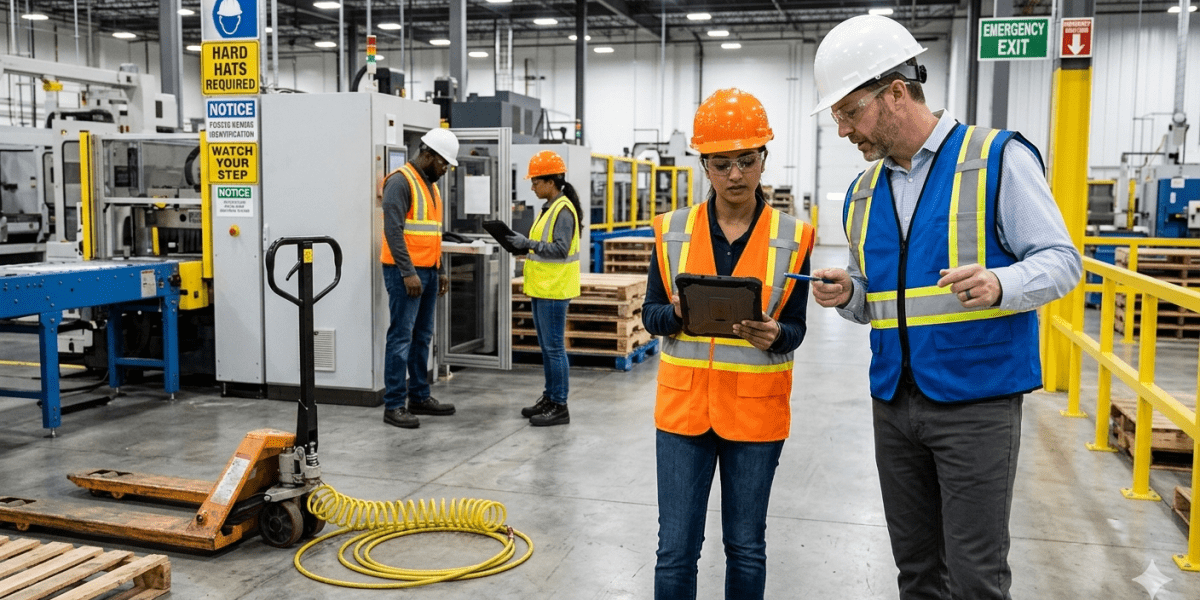
Discover the ultimate guide to Hazard Identification in the Workplace. Learn how to stay ISO 45001 compliant and create a proactive safety culture today.
Introduction to Hazard Identification
The journey toward a safer workplace begins with a simple but profound shift in perspective: safety is not a final destination, but a continuous process of observation and improvement. In today’s fast-paced industrial world, being able to spot potential dangers before they turn into life-altering accidents is what separates world-class organizations from the rest.
Hazard identification is the fundamental pillar of any serious occupational health and safety management system. It acts as the “eyes and ears” of your entire workforce. Without a structured way to identify risks, even the most expensive safety equipment is essentially useless. We have to look far beyond the obvious—like simple trips or falls—and dig into the complex web of chemical, biological, and psychological hazards that define the modern 21st-century workplace.
The global move toward ISO 45001 standards has changed the game. It has turned hazard identification from a boring “check-the-box” activity into a dynamic, risk-based way of thinking. This requires a total shift in mindset: moving away from a reactive culture (fixing things only after someone gets hurt) and toward a proactive culture (removing the threat before it ever strikes). This change is vital because the stakes are incredibly high. It’s not just about avoiding legal penalties or financial loss; it’s about the human cost. When we talk about identifying hazards, we are ultimately talking about protecting the people—the fathers, mothers, and children—who make up our team. It is a moral duty just as much as a legal one.
In many industries, the work environment is constantly shifting. A construction site looks different every morning; a chemical plant’s risks fluctuate with the temperature; and even a standard office faces new ergonomic and mental health challenges as technology evolves. Because of this, a one-time assessment is never enough. Hazard identification must be woven into the very fabric of daily operations. It needs to be the main topic of morning “toolbox talks,” the focus of shift changes, and a core part of the planning phase for every new project.
Furthermore, the “secret ingredient” to success is worker involvement. While managers bring the technical knowledge, the workers on the front line bring practical, lived experience. They are the ones who know which machine makes a strange vibration, which floor gets slick when the humidity rises, and which process feels “rushed.” By empowering your team to report these issues without fear, you create a culture with thousands of safety inspectors instead of just one.
Finally, let’s look at the legal side. Regulators like OSHA now demand “evidence of due diligence.” They want to see that your organization doesn’t just stumble upon risks, but has a documented, systematic approach. This documentation becomes your roadmap for training and spending. If you know where the hazards are, you know exactly where to put your safety budget for the best results. As we dive into these five steps, remember that each one builds on the last to create a total safety shield around your most valuable asset: your people.
Guide Overview:
- Step 1: Reviewing Existing Documentation
- Step 2: Conducting Site Inspections
- Step 3: Analyzing Workflow and Human Factors
- Step 4: Identifying Health and Environmental Hazards
- Step 5: Using the Hierarchy of Controls
The 5 Essential Steps
Step 1: Deep-Dive into Existing Documentation
Before you even step foot on the shop floor, you need to look at your “paper trail.” A truly professional approach to hazard identification starts with historical data. You should carefully review past accident reports, maintenance logs, and near-miss records. Patterns often hide in this data that aren’t visible to the naked eye. For example, if your logs show a specific piece of equipment keeps failing on Tuesday afternoons, there might be a mechanical hazard linked to a specific shift’s operating style.
You must also analyze your Manufacturer Safety Data Sheets (SDS). These documents are goldmines for identifying chemical hazards, flammability risks, and toxic exposure levels. By starting with the documentation, you build a “risk profile” that tells you exactly where to look when you start your physical inspection.
Step 2: Conduct a Boots-on-the-Ground Site Inspection
There is no substitute for a physical walkthrough. To master hazard identification, you have to get out there and see the facility in its raw state. Look for physical hazards like uneven floors or poorly lit corners. Check for mechanical hazards like moving parts without guards. Don’t forget electrical hazards—frayed cords or overloaded power strips are silent killers in both factories and offices.
During this step, use your phone to take high-quality photos. This isn’t just for memory; it’s for documentation. If you find a hazard, like a blocked emergency exit or a leaking pipe, a photo provides the “evidence of due diligence” that ISO 45001 auditors look for. It proves that you are actively and physically monitoring the workplace for changes that could lead to an incident.
Step 3: Observe Real-World Workflows and Human Factors
Sometimes the “official” way a job is supposed to be done isn’t how it actually happens. This is a critical part of hazard identification. Observe your workers in action. Are they taking “shortcuts” because the safe way is too slow? These shortcuts often introduce hidden, dangerous hazards that management never sees coming.
You also need to consider “Human Factors.” Are your people exhausted? Is the lighting causing eye strain? Is a desk at the wrong height, leading to long-term ergonomic injury? By watching how people interact with their space, you can identify hazards that aren’t about broken machines, but about poorly designed processes. The goal is to engineer the work so that the “safe way” is also the “easiest way.”
Step 4: Spotlight Health and Environmental Hazards
Not all dangers leave a bruise immediately; some are “invisible killers” that take years to show symptoms. A major part of hazard identification involves checking for things like high noise levels that lead to permanent hearing loss or poor air quality that causes respiratory issues.
In 2026, we also have to talk about “Psychosocial Hazards.” High-stress environments, workplace bullying, or extreme workloads can lead to mental health crises. Under modern safety standards, these are just as dangerous as a chemical spill. Identifying these requires a culture of trust. You need to know that your environment is healthy for the mind as well as the body.
Step 5: Apply the Hierarchy of Controls
Once you have finished your hazard identification and have a list of risks, you have to decide how to fix them. Don’t just jump to giving everyone gloves or masks (PPE)—that’s the weakest fix. Instead, follow the hierarchy:
- Elimination: Can you remove the danger entirely?
- Substitution: Can you use a safer chemical or machine?
- Engineering: Can you build a wall or a guard to keep people away from the danger?
- Administration: Can you change the schedule to reduce exposure?
- PPE: Use this only as your final safety net.
By using this systematic approach, you ensure that you aren’t just putting a bandage on a wound, but actually curing the problem at its source. This is the difference between a “basic” safety plan and a professional-grade safety culture.
Conclusion: Building a Safer Future
Successfully implementing hazard identification is not a task you can complete in a single day. It is an ongoing commitment to the well-being of every person who enters your facility. By following these five essential steps—from reviewing historical documentation to applying the hierarchy of controls—you are doing more than just satisfying ISO 45001 requirements; you are building a foundation of trust. When employees see that management is proactive about spotting and fixing risks, they become more engaged, productive, and loyal.
Remember, the goal of hazard identification in the workplace is to ensure that every worker returns home in the same condition they arrived. As you continue to refine your safety processes, stay focused on continuous improvement and open communication. A proactive safety culture is the most valuable asset any company can own, and it all starts with the simple act of looking closer at the world around you.
Mastering hazard identification in the workplace is the most effective way to guarantee long-term safety and ISO 45001 compliance for any professional organization.
Frequently Asked Questions (FAQs)
- What is the main goal of hazard identification?
The primary goal is to find and record potential risks to prevent workplace injuries and illnesses. - How often should hazard identification be performed?
It should be an ongoing process, with formal reviews conducted annually or whenever equipment and processes change. - Who is responsible for identifying hazards?
While management is legally responsible, every employee has a duty to identify and report hazards they encounter. - What is the difference between a hazard and a risk?
A hazard is something with the potential to cause harm, while risk is the likelihood that the harm will occur. - Can a hazard be completely eliminated?
Yes, through process redesign or removing a dangerous substance, many hazards can be entirely removed from the workplace. - What is a “near miss” in safety terms?
A near miss is an unplanned event that did not result in injury but had the potential to do so. - Does ISO 45001 require a specific hazard list?
No, it requires a systematic process for identification that is tailored to your specific organization’s activities.