In high-hazard industries—from process plants to corporate environments—safety management traditionally focuses on the physical: stronger hard hats, tighter procedures, and robust engineering controls. While essential, this reactive approach often ignores a fundamental human factor: psychological safety in industrial safety programs.
A workforce operating without mental well-being is a dangerous workforce. Fatigue, stress, and the fear of reporting errors are silent risk multipliers. Therefore, transitioning from mere compliance to a truly proactive safety culture requires integrating robust mental health and psychological safety frameworks into your operational DNA.
This comprehensive guide, tailored for corporate and industrial training, explains the core concepts, provides actionable psychological safety examples, and breaks down the leading psychological safety theory to help you build a resilient, zero-harm workplace.
What is psychological safety? Defining the Core Concepts
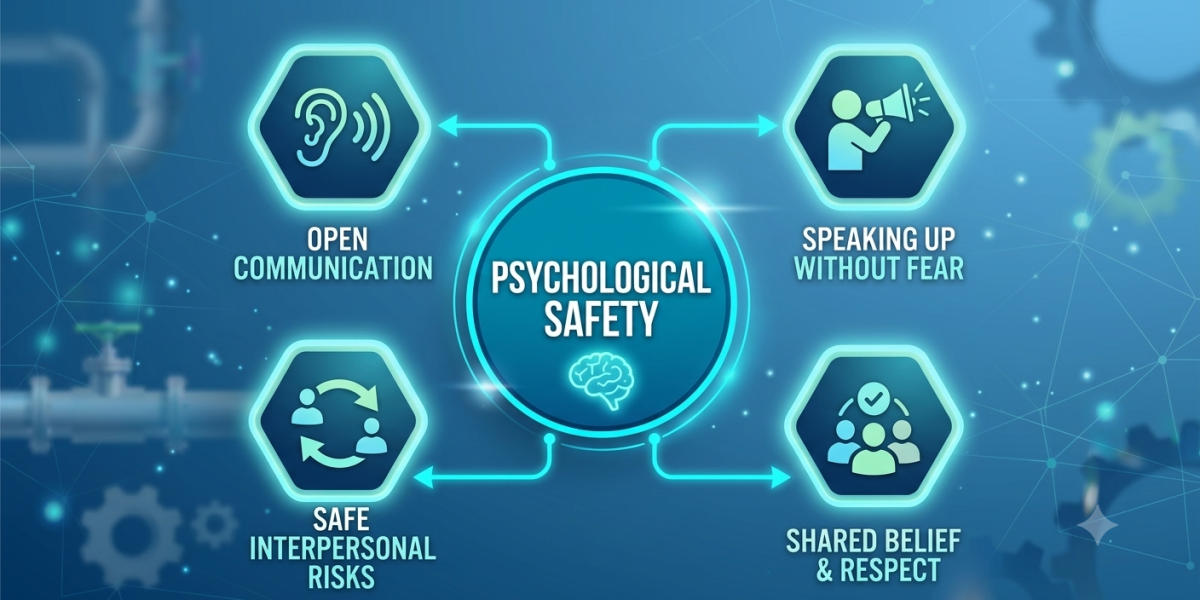
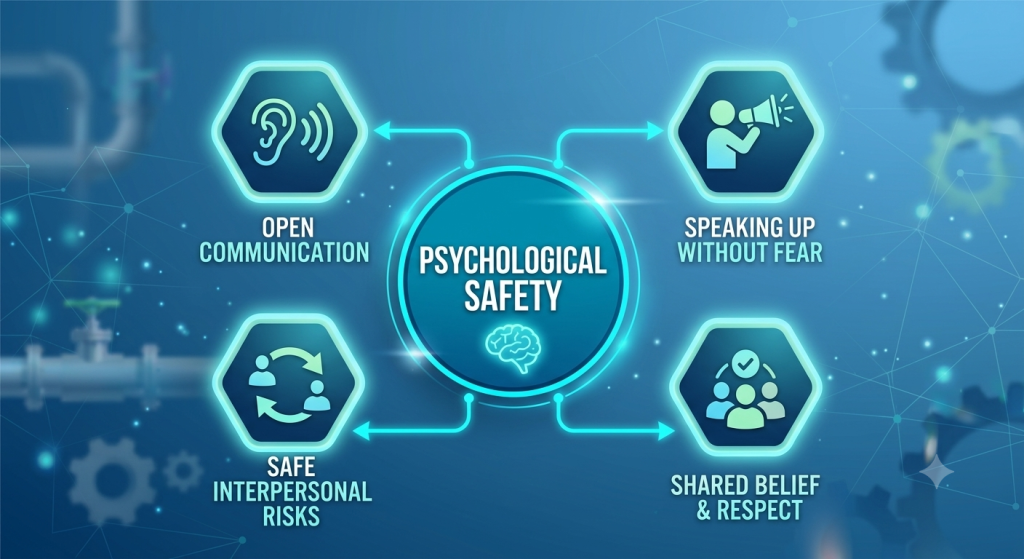
To implement it, we must first define it clearly. Psychological safety is not just about being polite; it is a shared belief that the workplace is a safe environment for taking interpersonal risks without fear of retaliation or humiliation.
In an industrial context, it means an operator feels safe halting production due to a perceived hazard or reporting a near-miss caused by their own mistake, knowing they will be supported, not punished. This environment directly facilitates mandatory process safety reporting required by standards like ISO 45001.
The Foundation of Psychological Safety Theory: Amy Edmondson
We cannot discuss this topic without highlighting the groundbreaking work of Amy Edmondson, the Novartis Professor of Leadership and Management at Harvard Business School. Edmondson’s seminal psychological safety theory revolutionized corporate and industrial safety thinking.
Her research established that teams operating with a high degree of psychological safety outperform others specifically in risk detection, innovation, and error correction. They learn faster and respond to emerging hazards more effectively. You can often find her core concepts summarized in a concise psychological safety PDF or within her essential psychological safety book, The Fearless Organization.
Edmondson defines a “fearless organization” not as one devoid of appropriate standards or discipline, but as one where the pursuit of high standards is enabled by a psychologically safe environment for challenging those standards when they create unnecessary risk.
Actionable Psychological Safety Examples in an Industrial Context
To make this concept tangible, let’s explore clear psychological safety examples contrasted with low-safety environments.
Low Psychological Safety Environment: A Recipe for Disaster
- The Scenario: A gas detector malfunctions during a maintenance shift in a chemical refinery.
- The Reaction: The operator notices the error but has observed previous colleagues being reprimanded for “wasting production time” on maintenance delays.
- The Outcome: The operator ignores the faulty sensor to maintain flow. An undetected leak occurs, leading to a catastrophic flash fire.
High Psychological Safety Environment: A Proactive Safety Culture
- The Scenario: A new junior technician notices a procedural step being skipped during a pipeline shutdown.
- The Reaction: The technician feels confident questioning the shift lead, citing the safety procedure.
- The Outcome: The shift lead thanks the technician, halts the procedure, verifies the correct step, and the team completes the shutdown safely. The technician is praised in the daily safety briefing for observing a hazard.
Meeting the “People Also Ask” Queries: Key Frameworks
To structure your implementation, it is useful to reference popular organizational models that answer common search queries.
What are the 4 types of psychological safety?
Timothy R. Clark, in The 4 Stages of Psychological Safety, defines a progression model. While not synonymous with types, these are the common categories searchers are looking for:
- Inclusion Safety: Feeling safe to belong and unique to the team.
- Learner Safety: Feeling safe to grow, ask questions, and make mistakes while learning.
- Contributor Safety: Feeling safe to make a contribution using your skills.
- Challenger Safety: Feeling safe to challenge the status quo, speak up, and provide critical input.
What are the 4 principles of psychological safety?
According to common implementation frameworks (including adapted principles from Amy Edmondson and Google’s Aristotle project):
- Lead by Example: Leaders must openly admit their own mistakes and model open communication.
- Actively Listen: Create space for all voices, validate concerns, and ask powerful questions.
- Frame Work as Learning: Shift from focusing solely on performance outcomes to continuous process improvement.
- Practice Constructive Feedback: Ensure feedback is focused on the issue, not the person, and is provided with the intent to improve safety and performance.
What are the 5 C’s of psychological safety?
While various consultants provide different “C’s,” a robust, modern framework focuses on these:
- Clarity: Clear, understandable standards and communication of safety goals.
- Connection: Building strong, supportive team dynamics and trust.
- Communication: Open, two-way dialogue across all hierarchies.
- Confidence: The belief that the organization values safety above speed or production.
- Compassion: Recognizing worker stress, fatigue, and mental well-being as critical risk factors.
Integration: A Vital Component of Process Safety Management
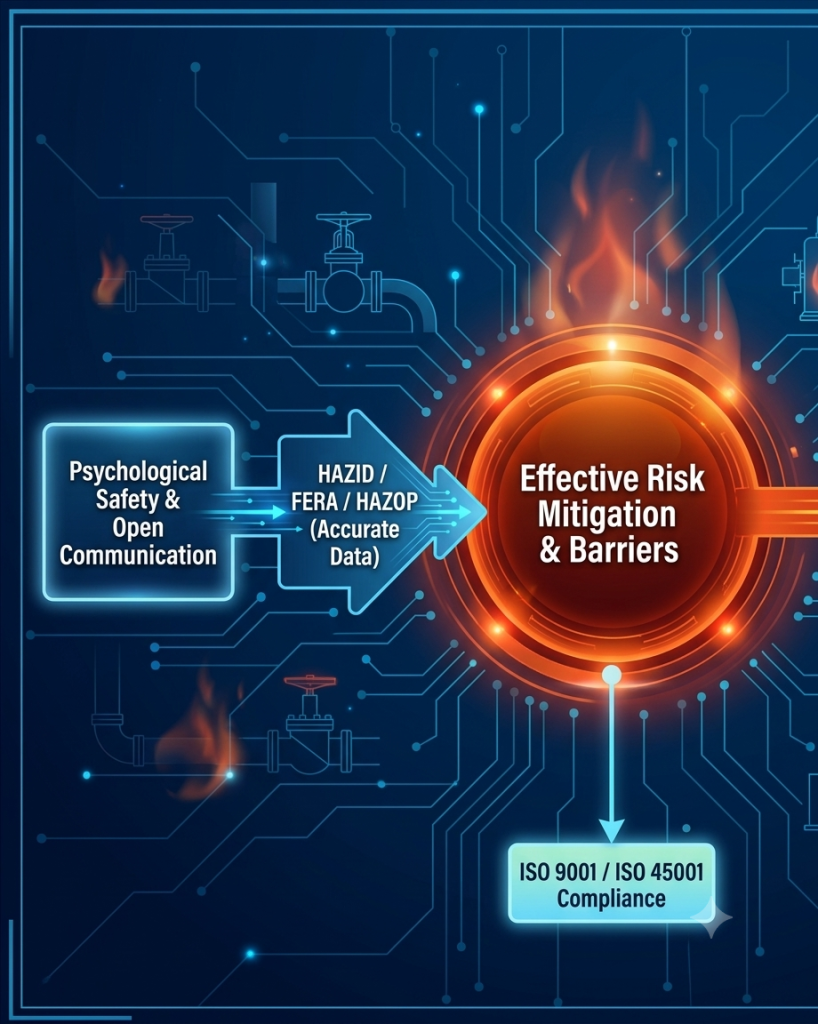
Integrating mental health and psychological safety into your corporate structure is not a “soft skill” option; it is a vital technical component of Process Safety Management (PSM) and ISO 9001 quality systems.
Impact on Risk Detection (FERA & HAZOP)
During detailed risk assessments like a FERA (Fire and Explosion Risk Assessment) or HAZOP (Hazard and Operability Study), the primary data comes from the expert operators. If those operators are too intimidated by leadership to disclose the true everyday operating challenges or “near-miss” operational workarounds, your FERA analysis will fail to model the correct risk scenarios.
By prioritizing psychological safety in industrial safety programs, you ensure that your technical studies are based on accurate, honest operational data.
How to Create Psychological Safety: Your Corporate Action Plan
The number one question corporate managers ask is, “How do you create psychological safety?” It must be actively built through deliberate leadership and structured training.
Corporate & Management Level Actions
- Leadership Training: Managers at all levels must be trained to recognize the mental health impacts of fatigue and stress. Training should focus on empathy, active listening, and the 4-stage model.
- Establish No-Blame Reporting: Replace “who is responsible?” with “what happened, why, and how can we prevent it?”
- Measure and Audit Safety Culture: Conduct regular, anonymous surveys to measure the current level of psychological safety among shift teams. Include these scores in your corporate safety scorecards alongside standard LTIFR (Lost Time Injury Frequency Rate) metrics.
Frontline and Operational Actions
- Pre-Shift Mental Health Check-ins: Start safety briefings with a simple, quick pulse check on fatigue or stress levels.
- Praise Speaking Up: Publicly and immediately validate anyone who raises a safety concern, especially if it stops production or requires backtracking.
- Continuous Training: Regularly include modules on recognizing and mitigating fatigue, managing stress, and team communication in your mandatory corporate training curriculum.
Conclusion: Achieving Zero Harm Through Total Worker Safety
Achieving a zero-harm workplace means looking beyond mechanical reliability and process barriers; it means investing in human reliability. By prioritizing psychological safety in industrial safety programs, you move your organization from compliance-driven bureaucracy to a resilient, proactive, and learning-based safety culture.
Integrating mental health and psychological safety into your operational DNA reduces accidents, improves productivity, and fulfills your regulatory and moral obligations.
🙋♀️ Psychological Safety Frequently Asked Questions (FAQs)
What is psychological safety at the workplace?
Psychological safety at the workplace is the shared belief that team members will not be humiliated, punished, or excluded for speaking up, asking questions, raising concerns, or admitting mistakes. It is an environment of mutual trust where interpersonal risks are accepted and valued.
What is personal psychological safety?
Personal psychological safety refers to an individual’s own sense of mental well-being and their perception of a supportive, low-threat environment where they feel comfortable being their authentic self and taking intellectual risks without severe internal distress or anxiety.
Does psychological safety apply at home and in personal life?
Yes, psychological safety at home and in personal psychological safety contexts is just as vital. A psychologically safe home is an environment where family members can share feelings, express dissent, make mistakes, and navigate challenges without fear of conditional love, judgment, or domestic instability.
Are there differences between industrial and corporate psychological safety implementation?
Yes. Corporate implementation (like IT or finance) often focuses on innovation and challenging business decisions. Industrial implementation focus is strictly operational: facilitating immediate safety intervention (stop work authority) and ensuring robust, honest reporting of physical hazards and near misses.
How does psychological safety affect business performance?
High psychological safety directly improves business performance by facilitating effective risk detection, speeding up decision-making, increasing employee retention, and fostering innovation through continuous learning.