
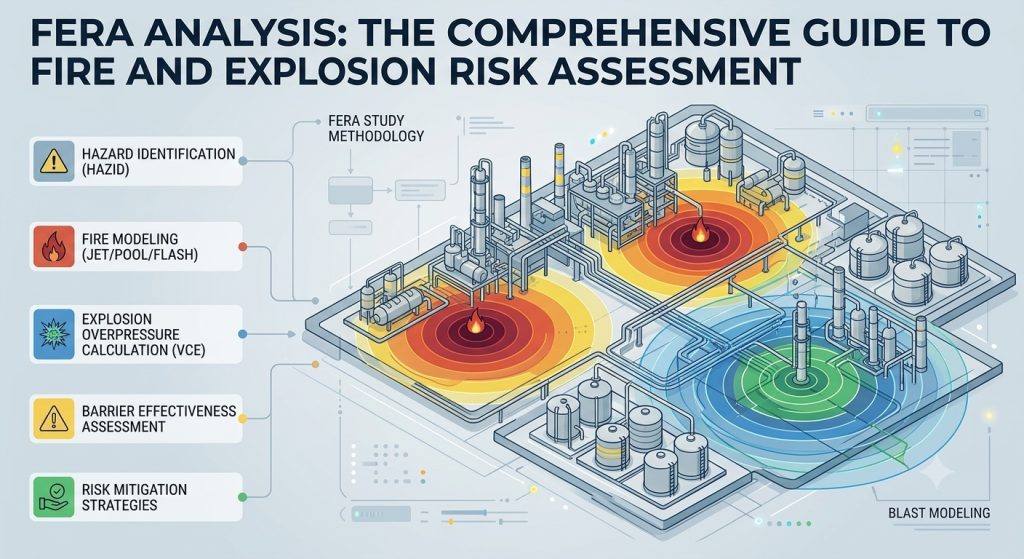
In hazardous industrial environments, conducting a proper FERA Analysis is essential for maintaining process safety. Reactive safety measures are no longer acceptable, and the potential consequences of an incident—catastrophic asset loss, environmental damage, and loss of life—demand a robust, proactive approach to risk management.
Central to this proactive strategy is the Fire and Explosion Risk Assessment, commonly referred to as FERA analysis.
This definitive guide provides an in-depth examination of the FERA methodology, detailing why it is an indispensable tool for complex industrial operations. We will explore how a thorough FERA study can revolutionize your approach to process safety, drastically reduce operational risks, and integrate seamlessly with broader quality standards like ISO 9001. If your goal is to transition from simple compliance to a resilient culture of safety excellence, mastering FERA is essential.
Defining FERA Analysis: What is a Fire and Explosion Risk Assessment?
A Fire and Explosion Risk Assessment (FERA) is a systematic, structured evaluation designed to identify and quantify the potential hazards associated with fires and explosions in industrial facilities.
Unlike a general workplace risk assessment, a FERA analysis is a specialized, technical study. It specifically analyzes scenarios involving flammable materials—liquids, gases, or dusts—that could release, ignite, and escalate into major accident events (MAEs).
The primary objectives of a comprehensive FERA study are to:
- Identify all potential ignition sources and release scenarios.
- Assess the effectiveness of existing preventative and mitigation barriers.
- Evaluate the consequences (thermal radiation, overpressure) on personnel and assets.
- Provide actionable recommendations to reduce risk to ALARP (as low as reasonably practicable) levels.
Why a Thorough FERA Study is Vital for Hazardous Industries
The importance of a robust FERA cannot be overstated. Beyond the moral imperative of protecting employees, a well-executed FERA analysis offers significant strategic advantages to an organization.
Operational Risk Reduction and Asset Protection
Industrial operations in sectors such as oil and gas, petrochemicals, and power generation are inherently high-risk. A single uncontrolled fire or explosion can cause catastrophic, irreversible damage.
By rigorously modeling explosion overpressures and fire consequences, a FERA study allows engineers to identify critical equipment and structural vulnerabilities. This intelligence enables organizations to implement targeted reinforcement, optimize equipment layout, and design robust passive fire protection (PFP) systems, ensuring that even if an incident occurs, its escalation is contained.
Improving Personnel Safety and Emergency Response
Protecting people is the ultimate goal. A FERA analysis evaluates the impact of fire and explosion scenarios on escape routes, temporary refuges (TRs), and emergency shutdown (ESD) systems. By understanding the timeline and magnitude of a potential incident, facilities can develop effective, evidence-based emergency response plans and ensure that critical safety systems remain operational during a crisis.
Integrating FERA Analysis with ISO 9001 Quality Management Systems
A major advantage of a well-documented FERA process is its ability to support and enhance an organization’s ISO 9001 Quality Management System.
While ISO 9001 is not a safety standard itself, it provides the fundamental framework for consistent risk management across all operational processes.
ISO 9001, Clause 6.1: Actions to Address Risks and Opportunities
ISO 9001 requires organizations to proactively identify risks and opportunities that affect performance. A standardized FERA analysis serves as concrete evidence that a facility has rigorously assessed the risk of major accidents, satisfying this core requirement of the QMS. By documenting the FERA process—from hazard identification to the validation of safety barriers—companies demonstrate that their commitment to “quality” includes the critical pillars of safety and reliability.
To learn more about optimizing your operational processes, check out our guide on Quality Management Systems
or visit our Contact Page to speak with an expert.
The FERA Analysis Methodology: A Step-by-Step Approach
A proper FERA analysis follows a standardized, quantitative, or semi-quantitative methodology. Understanding this process is key to ensuring the study delivers actionable value.
Step 1: Data Gathering and Scope Definition
The process begins with a complete review of the facility. This includes Process Flow Diagrams (PFDs), Piping and Instrumentation Diagrams (P&IDs), hazardous area classification drawings, equipment lists, and details of all flammable materials handled on-site. The geographical boundaries and the objectives of the FERA study are strictly defined.
Step 2: Hazard Identification (HAZID)
Using techniques like HAZID or What-If analysis, engineers identify all credible fire and explosion scenarios. This includes releases from piping, vessel failures, storage tank fires, and dust explosions in manufacturing processes.
Step 3: Consequence Analysis and Modeling
This is the technical heart of the FERA study. Specialized software is used to model the behavior of release scenarios. Engineers quantify:
- Jet Fires: From high-pressure gas leaks.
- Pool Fires: From liquid spills on the ground.
- Flash Fires: From ignited gas clouds.
- Vapor Cloud Explosions (VCEs): Modeling the overpressure generated by the explosion.
This step calculates thermal radiation contour lines and blast overpressure maps, showing exactly where danger zones exist.
Step 4: Frequency Assessment
Engineers estimate the probability or frequency of each identified scenario occurring. This uses historical failure data, process conditions, and complexity analysis to determine how often a release or ignition might happen.
Step 5: Risk Evaluation and Mitigation Recommendations
The final step is to combine consequence and frequency data to determine the overall risk level for each scenario. These risks are then compared against the company’s risk acceptance criteria. If a scenario exceeds the criteria, the FERA analysis provides specific, actionable recommendations. These may include:
- Adding gas detection systems.
- Automating fire suppression.
- Relocating critical equipment.
- Enhancing blast resistance of control rooms.
The Different Types of Assessments: FERA Fire vs. FERA Explosion
While often discussed together, it is vital to distinguish between the focus areas within a complete FERA study.
FERA Fire Assessment (Thermal Hazards)
A FERA fire assessment focuses primarily on the thermal radiation impacts. It analyzes:
- Impact on structural integrity (PFP requirements).
- Thermal loading on process vessels and piping (potential for BLEVE).
- Impairment of escape routes for personnel.
- Functionality of active fire protection (deluge systems).
FERA Explosion Assessment (Overpressure Hazards)
A FERA explosion assessment focuses on the generation of overpressure waves. It evaluates:
- Deflagration and detonation modeling within process structures.
- Blast wave impact on buildings, control rooms, and sensitive equipment.
- Missile hazards generated by equipment fragmentation.
- Overpressure impact on the human body (hearing damage, pulmonary injury).
Driving Continuous Improvement with FERA Study Data
A FERA analysis should not be treated as a one-time “checkbox” document. It is a live resource designed to drive continuous improvement in facility safety.
Regularly reviewing and updating the FERA study—especially after significant process changes, new equipment installations, or following incident investigations—is essential. This ongoing cycle of review and update directly supports the principles of improvement found in both safety management and ISO 9001 frameworks.
Furthermore, integrating FERA data with other safety studies, such as Quantitative Risk Assessment (QRA) and Layers of Protection Analysis (LOPA), provides a holistic, comprehensive view of a facility’s entire risk landscape.
Conclusion: FERA analysis is the foundation of industrial resilience.
Mastering Fire and Explosion Risk Assessment is no longer a luxury—it is a baseline requirement for responsible industrial operations. The detailed methodology of a FERA study allows facilities to transition from reactive management to proactive safety, saving lives, protecting assets, and securing regulatory compliance.
Don’t wait for an incident to occur before evaluating your vulnerabilities. Investing in a thorough FERA analysis today is the most critical step you can take toward building a culture of resilient, effective, and enduring workplace safety.
FERA Analysis Frequently Asked Questions (FAQs)
What does FERA stand for in risk management?
FERA stands for Fire and Explosion Risk Assessment. It is a specialized, technical process designed to systematically identify, evaluate, and mitigate the specific risks of fire and explosion scenarios in industrial and hazardous environments.
How does a FERA study differ from a regular fire risk assessment?
A regular Fire Risk Assessment (FRA) is typically a qualitative evaluation focused on life safety in standard buildings (e.g., offices and commercial spaces), analyzing elements like fire doors, alarms, and extinguishers. A FERA study is a highly complex, technical, and often quantitative analysis used in process industries (oil, gas, and chemical). It involves detailed dispersion modeling, thermal radiation calculations, and explosion overpressure analysis for Major Accident Events (MAEs).
Is a FERA analysis required by law?
While the term “FERA” might not be universally explicitly named in all regulations, its core components are required by safety laws globally for hazardous facilities (e.g., the Seveso Directive in Europe or OSHA PSM standards in the USA). Regulations demand that operators of major hazard installations rigorously identify hazards, model consequences, and implement barriers to reduce major accident risks to ALARP (As Low As Reasonably Practicable) levels, a requirement that a FERA analysis is specifically designed to satisfy.
When should an organization conduct a FERA study?
A FERA analysis should be initiated during the front-end engineering design (FEED) phase of a new project to optimize layout and minimize risk by design. However, it must also be updated periodically for existing facilities (typically every 5 years) and whenever significant changes are made to the process, equipment, flammable material inventories, or overall facility layout.