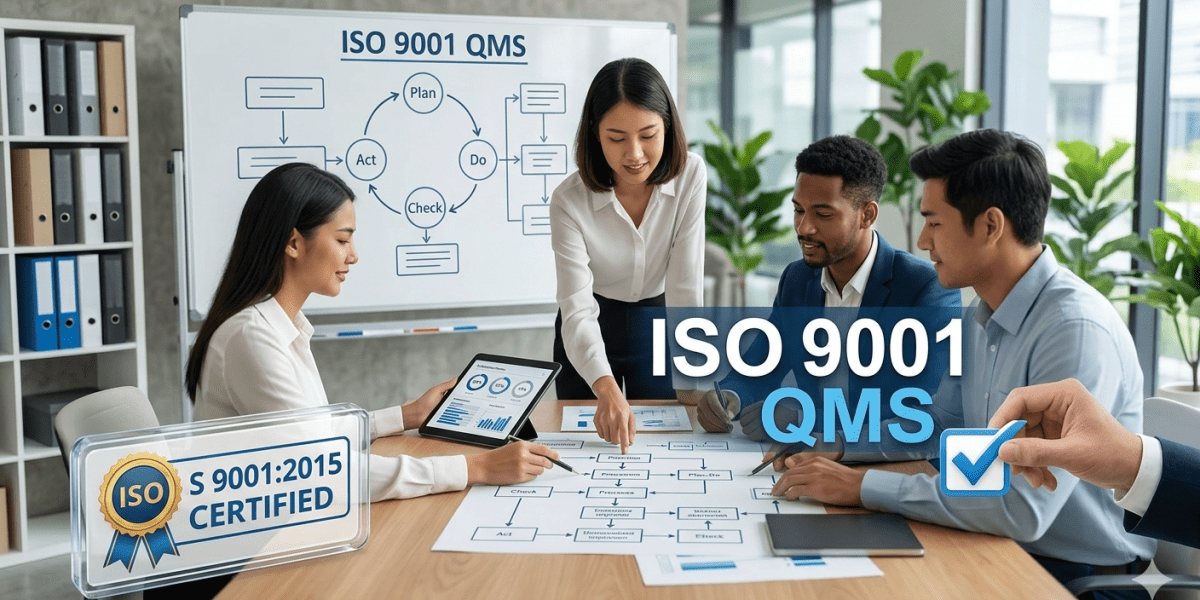
ISO 9001 Quality Management System (QMS) is the international standard that specifies requirements for a quality management system. Organizations use the standard to demonstrate the ability to consistently provide products and services that meet customer and regulatory requirements. In today’s competitive market, having a robust ISO 9001 Quality Management System is not just an option—it is a necessity for any business looking to scale and maintain a high level of customer satisfaction.
Before starting your quality journey, it is helpful to understand the basics of workplace safety by reading our Occupational Health and Safety Guide.
What is ISO 9001?
The ISO 9001 standard is based on a number of quality management principles including a strong customer focus, the motivation and implication of top management, the process approach, and continual improvement. It follows a high-level structure (Annex SL), which makes it compatible with other management systems. Implementing an ISO 9001 Quality Management System ensures that customers get consistent, good-quality products and services, which in turn brings many business benefits, including reduced waste and increased productivity.
The Seven Principles of QMS
To truly master the ISO 9001 Quality Management System, one must move beyond the technical jargon and understand the philosophical pillars that hold the standard together:
- Customer Focus: The primary focus is to meet customer requirements and strive to exceed customer expectations. Every interaction is an opportunity to create more value.
- Leadership: Leaders at all levels establish unity of purpose and direction. They create conditions in which people are engaged in achieving the organization’s quality objectives.
- Engagement of People: It is essential for the organization that all people are competent, empowered, and engaged in delivering value. This is the “human” side of quality.
- Process Approach: Consistent and predictable results are achieved more effectively when activities are understood and managed as interrelated processes that function as a coherent system.
- Improvement: Successful organizations have an ongoing focus on improvement. Reacting to changes in the internal and external environments is necessary to maintain performance levels.
- Evidence-based Decision Making: Decisions based on the analysis and evaluation of data and information are more likely to produce desired results.
- Relationship Management: For sustained success, an organization manages its relationships with interested parties, such as suppliers, to optimize their impact on performance.
Why Your Business Needs ISO 9001 Quality Management System
Implementing an ISO 9001 Quality Management System helps you streamline your processes and reduce errors. Whether you are in the manufacturing sector or provide services like software engineering, the framework provides a “Plan-Do-Check-Act” (PDCA) cycle.
In the modern digital economy, documentation and repeatability are the keys to scaling. Without a systemized approach, tribal knowledge stays trapped in the heads of a few senior employees. ISO 9001 forces you to institutionalize that knowledge, ensuring that every department is aligned with the company’s core quality goals.
Benefits of Certification
The transition to a certified ISO 9001 Quality Management System offers tangible returns on investment:
- Improved Efficiency: By following the guidelines, you identify wasteful processes and bottlenecks that cost time and money.
- Better Risk Management: The 2015 revision of the standard introduced “Risk-Based Thinking.” You learn to identify risks and opportunities before they become expensive problems.
- Global Recognition: ISO is recognized in Dubai, Saudi Arabia, and across the globe. In many international markets, being ISO 9001 certified is a prerequisite for bidding on government or large-scale corporate contracts.
- Enhanced Brand Reputation: Certification acts as a badge of trust, signaling to stakeholders that you are committed to professional excellence.
Detailed Steps to Implement ISO 9001
To successfully launch an ISO 9001 Quality Management System, you must follow a structured path that avoids shortcuts.
1. Gap Analysis
This is the “reality check” phase. Compare your current processes against the ISO 9001 requirements. Are you already meeting the standard in your customer service but failing in your supplier management? This identifies what you are already doing right and where you need to invest resources to improve.
2. Documentation
This is the most labor-intensive part of the journey. You must document your quality policy, quality objectives, and the scope of the QMS.
- The Quality Manual: While no longer strictly mandatory for some versions, it remains a best practice to have a central document that outlines your system.
- Standard Operating Procedures (SOPs): Detailed instructions on how tasks are performed.
- Records: The evidence that your processes are actually being followed.
This is where your technical writing skills come into play to ensure the manual is clear for all employees. For the official technical requirements, check the ISO International Organization for Standardization.
3. Training and Awareness
You cannot implement a system in a vacuum. Every employee—from the CEO to the junior developer—must understand their role in the ISO 9001 Quality Management System. They don’t need to memorize the standard, but they do need to know how their daily work affects quality and customer satisfaction.
4. Internal Audit
Before the official certification body arrives, perform an internal audit. This is a “dry run” to ensure that the system is functioning as intended. It is a critical step to catch non-conformities early. If an auditor finds an issue during the real exam, it could delay your certification by months.
5. Management Review
The top management must review the QMS at planned intervals to ensure its continuing suitability, adequacy, and effectiveness. This ensures the system is not just a stack of papers but a living part of the business strategy.
Common Challenges
Many organizations struggle with the “Engagement of People” phase. Change is often met with resistance. It is vital to communicate that the ISO 9001 Quality Management System is a tool to help employees work smarter, not a way to monitor or micromanage them. Another common pitfall is over-documenting; creating too much paperwork can lead to “ISO fatigue,” where the system becomes a burden rather than a benefit.
Conclusion
ISO 9001 Quality Management System remains the gold standard for organizations committed to excellence. By following the principles of this framework, companies can ensure long-term sustainability, better risk management, and a culture of continuous improvement. If you want your business to stand out in the global marketplace, starting your journey with an ISO 9001 Quality Management System is the most effective first step you can take toward a future of operational brilliance and customer loyalty.
FAQs (Frequently Asked Questions)
- What is the main goal of ISO 9001?
The primary goal is to provide a framework that ensures consistent product and service quality while enhancing customer satisfaction through the effective application of the system. - How long does certification take?
Most organizations take between 6 to 12 months, depending on their current size, complexity, and the gap between their current processes and the standard requirements. - Is ISO 9001 mandatory?
It is not legally required by international law, but many industries and high-value clients require it as a mandatory condition for doing business. - Can small businesses get ISO 9001?
Yes, the standard is designed to be scalable. A one-person consultancy can be certified just as easily as a multi-national corporation. - Who issues the certificate?
ISO develops the standards, but they do not issue certificates. Independent, third-party certification bodies (like BSI, SGS, or Intertek) perform the audit and issue the official certificate.